
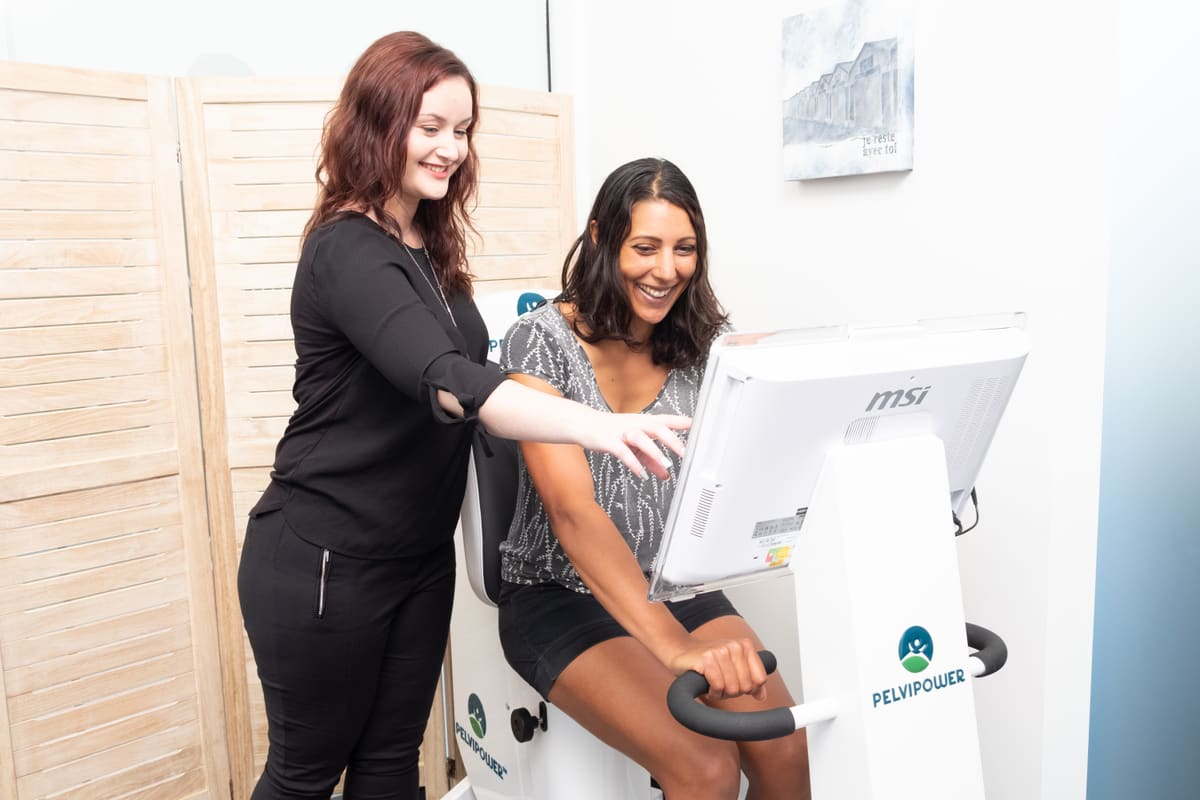
Learn to feel, understand and improve the way your pelvic floor works.
Most people can’t see what their pelvic floor is doing.
Many can’t feel it accurately either.
That makes rehabilitation difficult.
You may think you’re performing a pelvic floor contraction correctly when you’re actually pushing down, holding your breath, using the wrong muscles or failing to relax afterwards.
Real-time biofeedback changes that.
By providing immediate visual feedback, it helps you understand how your pelvic floor is working, improve technique and build confidence throughout rehabilitation.
At CoreGood, biofeedback isn’t simply about measuring muscle activity.
It’s about helping you learn to use one of the most important muscle systems in your body more effectively.
What Is Real-Time Pelvic Floor Biofeedback?
Real-time biofeedback is a rehabilitation tool that provides immediate visual information about how your pelvic floor muscles are working.
Instead of relying on guesswork, you receive instant feedback that helps you recognise whether you’re contracting, relaxing and coordinating your pelvic floor correctly.
Like looking in a mirror while learning a new movement, biofeedback transforms something you can’t normally see into something you can understand and improve.
Unlike PelviPower, which stimulates the muscles, biofeedback helps you actively learn how to control them.
Why Biofeedback Accelerates Learning
Learning any new movement depends on feedback.
The pelvic floor is different because you usually can’t see it and many people struggle to feel whether they’re using it correctly.
Real-time biofeedback removes that guesswork. By seeing your muscles respond as you move, breathe and exercise, you learn faster, improve confidence and develop healthier movement patterns that carry over into everyday life.
Improve Muscle Awareness
Biofeedback helps you recognise what an effective contraction and complete relaxation feel like, making it easier to repeat correctly during rehabilitation and at home.
Improve Coordination, Breathing & Pressure Management
Healthy pelvic floor function depends on the pelvic floor working together with your diaphragm, abdominal muscles and breathing.
Biofeedback allows you to practise these movement patterns in real time, improving coordination, pressure management and automatic control during lifting, exercise, sport and everyday activities.
This is particularly valuable for people with bladder leakage, pelvic organ prolapse, pelvic pain, post-prostate rehabilitation and anyone returning to exercise.
Learn to Relax
Many pelvic floor problems aren’t caused by weakness.
Some occur because the muscles remain too active or don’t relax when they should.
Biofeedback helps you reduce unnecessary muscle guarding and develop healthier patterns of muscle control.
Build Confidence
One of the biggest barriers to successful rehabilitation is uncertainty.
Seeing your muscles respond correctly provides immediate reassurance that you’re practising the right movement, improving motivation and confidence throughout rehabilitation.
How Better Pelvic Floor Control Can Improve Different Conditions
Learning to use your pelvic floor more effectively can improve a wide range of symptoms by restoring healthier, more automatic movement patterns.
Bladder Leakage
Improve the timing, coordination and strength of pelvic floor contractions to better support bladder control during coughing, lifting, exercise and everyday activities.
Urgency & Overactive Bladder
Improve pelvic floor awareness, relaxation and voluntary control to support bladder training and reduce urgency.
Pelvic Pain
Learn to reduce unnecessary muscle guarding, improve breathing and restore healthier movement patterns.
Recovery After Prostate Surgery
Reconnect with your pelvic floor, improve muscle awareness and develop better coordination during recovery.
Erectile Dysfunction & Premature Ejaculation
Improve pelvic floor awareness, coordination and control where pelvic floor dysfunction contributes to symptoms.
Pelvic Organ Prolapse
Improve pelvic floor support, breathing and pressure management during lifting, exercise and everyday life.
Is Biofeedback Right for Me?
You don’t need to know whether biofeedback is the right rehabilitation tool before reaching out.
That’s our job.
We’ll assess how your pelvic floor is functioning and determine whether real-time biofeedback is likely to help you learn more effectively as part of your personalised rehabilitation programme.
If it’s appropriate, we’ll explain why. If another approach is likely to achieve a better outcome, we’ll recommend that instead.
Common Questions
Does biofeedback hurt?
No. Real-time biofeedback provides information rather than stimulation and is generally completely comfortable.
Will I need to undress?
Not necessarily. Many people begin rehabilitation using non-invasive technologies such as real-time ultrasound biofeedback or external biofeedback systems. If an internal assessment would provide important additional information, we’ll explain why and only proceed with your consent.
Is biofeedback the same as pelvic floor exercises?
No. Biofeedback doesn’t replace rehabilitation—it improves it by helping you learn correct technique more quickly and accurately.
Can biofeedback help if my pelvic floor is overactive?
Yes. Biofeedback is equally valuable for teaching relaxation, breathing coordination and reducing unnecessary muscle activity as it is for teaching muscle activation.
How many sessions will I need?
This depends on your symptoms, goals and how quickly your pelvic floor adapts. Many people notice improved awareness early, while others benefit from biofeedback over several appointments as new movement patterns become automatic.
Ready to Learn How Your Pelvic Floor Really Works?
You don’t need to guess whether you’re using your pelvic floor correctly.
That’s our job.
We’ll assess how your pelvic floor is functioning and determine whether real-time biofeedback is likely to help you learn more effectively as part of your personalised rehabilitation programme.
If it’s the right tool, we’ll explain why. If another approach is likely to produce a better outcome, we’ll recommend that instead.
Take the First Step
You don't need to know exactly what's wrong before asking for help. If you would rather ask before you book, start with a free 15-minute discovery call. It is a phone conversation, not a sales call, and there is no obligation to book anything afterwards.