
The Pelvic Floor Chair, Explained Properly
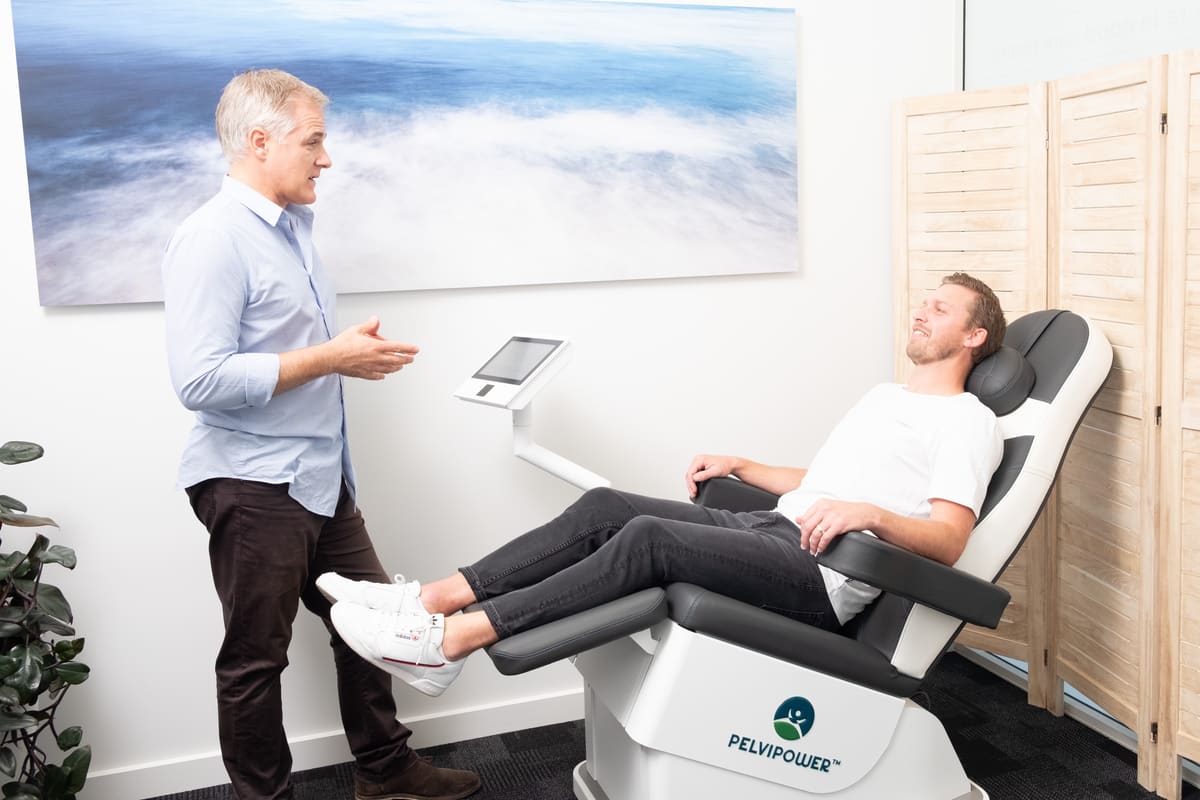
PelviPower is a chair that uses repetitive magnetic impulses to produce contractions of the pelvic floor and surrounding muscles while you sit on it, fully clothed. It is one of several magnetic stimulation chairs available internationally, and CoreGood is the New Zealand distributor.
If you have found this page while working out whether a pelvic floor chair is worth your money, this is a page written to answer that rather than to sell you a course of sessions. It includes the parts most chair pages leave out: who it is not suitable for, what it will not do, and the questions worth asking any clinic before you book.
What Is a Pelvic Floor Chair?
A pelvic floor chair is a seat containing a coil that generates a rapidly changing magnetic field. That field passes straight through clothing, skin and bone. Inside your tissue it induces a small electrical current, and where that current reaches a motor nerve it depolarises the nerve, causing the muscle fibres it supplies to contract.
The contraction is produced by your own nerves and your own muscles. The chair supplies the trigger.
Because the field comes from the seat, the muscles of the pelvic floor are recruited along with surrounding muscles of the pelvis, hips and buttocks. Impulses are delivered in repeated cycles of contraction and rest, at an intensity set by the clinician and adjusted to what you can comfortably tolerate.
You sit on it in your ordinary clothes. Nothing is inserted, nothing is attached to your skin, and you do not undress.
What Is a Session Actually Like?
You sit down and are positioned, because where you sit relative to the coil determines which muscles get recruited. The intensity starts low and is built up while you say what you can feel and where.
Most people describe the sensation as a strong tapping or pulling, with a distinct muscle contraction they are not producing themselves. It is unfamiliar rather than sore. It should not hurt, and if it does, the intensity comes down.
A session runs 20 to 30 minutes. You can read or talk through it. Afterwards you get up and go, with no recovery time and no restrictions. Some people feel the muscles the next day the way you would after unfamiliar exercise.
Who Is PelviPower Available For?
PelviPower can be used by men and women across a wide range of presentations, wherever improving pelvic floor function forms part of the rehabilitation plan.
Strengthening is not the only thing it does. Functional magnetic stimulation can be delivered at different frequencies and intensities, and on different programmes, depending on what we are trying to achieve.
For some people the goal is pelvic floor recruitment, strength or endurance. For others it is coordination, awareness and neuromuscular control. We may also use carefully selected stimulation parameters as part of rehabilitation where there is increased pelvic floor tone or pelvic pain, with treatment progressed according to how you respond.
This is why the assessment comes first. Rather than deciding whether your pelvic floor is “weak” or “tight”, we look at how well it recruits, how well it releases, how the two coordinate, what your symptoms are, and what appears to be limiting normal function. From there we can decide whether PelviPower has a useful role for you, and choose the programme, frequency and intensity accordingly.
The chair provides the neuromuscular stimulus. How we use that stimulus depends on what your pelvic floor needs.
That is also why CoreGood does not sell chair sessions without an assessment first. Your symptoms on their own will not tell either of us which direction of work you need.
What a Chair Will Not Do
It will not tell you why you are leaking. It produces contractions; it does not assess anything, and it has no way of knowing whether contraction is what you need.
It will not change your bladder habits, your fluid intake, your constipation or the way you brace when you lift, all of which are common contributors to the symptoms that bring people to a chair in the first place.
It will not teach you to use the muscle in daily life. Recruiting a muscle passively and being able to use it when you cough, lift or sneeze are different things, and the second one is usually the goal.
It is not a substitute for pelvic health physiotherapy. It is one component that may sit inside a programme.
Technology supports clinical reasoning. It never replaces it.
Who Is a Pelvic Floor Chair Not Suitable For?
Magnetic stimulation is not appropriate for everyone. Tell the clinic about all of the following before you book, at any clinic, on any chair:
- Implanted electronic devices including pacemakers, defibrillators and neurostimulators
- Significant cardiac arrhythmia
- Metal implants within the field: hip joint replacements, surgical clips, plates, screws, stents, mesh, intrauterine devices containing metal, and pelvic piercings. A knee replacement sits outside the field and is not a problem
- Pregnancy, or possible pregnancy
- An intrauterine device of any kind, which should be checked against the manufacturer’s guidance before your first session
- Epilepsy or any seizure disorder
- Active or recent malignancy in or near the area
- Recent pelvic surgery or radiation therapy
- Active infection or fever
- Bleeding disorders or anticoagulant medication
- Impaired sensation in the pelvic region
Read the full detail on our PelviPower clinical page.
What Should I Ask Before Booking a Pelvic Floor Chair Anywhere?
Several magnetic stimulation chairs are marketed in New Zealand, from different manufacturers, and clinics offering them vary widely in how they use them. We are not going to tell you that one chair beats another, because that is a claim we could not properly substantiate and you should be sceptical of anyone who does.
What we can give you is the list of questions worth asking whoever you end up booking with, including us.
- Will I be assessed before I start, and by whom? If the answer is that you can book a block of sessions straight away, you are buying a product, not receiving care.
- How will you know whether contraction is the right direction for my problem? There is a real answer to this and it involves measuring something.
- What are the contraindications, and will you screen me for them before I sit down?
- What is the cost per session, and am I being asked to commit to a package before assessment?
- How will progress be measured, and what happens if it does not change?
- Who is operating the device, and what are their qualifications?
- What else is in the plan? A chair on its own addresses one part of a picture that usually has several.
Ask us those questions too. We would rather answer them than have you assume.
Where Can I Try PelviPower in New Zealand?
| Detail | |
|---|---|
| CoreGood Kāpiti | 2 Seaview Road, Paraparaumu Beach, Paraparaumu 5032 |
| CoreGood Palmerston North | OraKinetics, The Pillars (next to Milson Pharmacy), 91 Milson Line, Palmerston North 4410 |
| Chairs | Both clinics have a PelviPower chair and a PelviPower biofeedback trainer |
| Other clinics with a chair | Ring 0800 267 346 and we will tell you where your nearest one is |
| Assessment first | Yes |
| Session fee | $140, not ACC funded |
| Clothing | Stay fully dressed |
| GP referral | Not required |
| Free 15-minute discovery call | No charge, ring 0800 267 346 |
CoreGood is the New Zealand distributor of the PelviPower chair, as well as a clinic that uses one. We think you should know that when you read anything we write about it.
Common Questions
Do pelvic floor chairs work?
There is a substantial and growing body of research investigating pelvic floor magnetic stimulation, particularly for urinary incontinence.
Studies have reported improvements in measures such as urinary leakage, bladder control and pelvic floor muscle function following magnetic stimulation. Research has also examined its use alongside conventional pelvic floor muscle training rather than as a replacement for active rehabilitation, and a 2026 randomised trial comparing the two found both groups improved, with no significant difference between them.
We are not going to give you a percentage. The figures circulating in chair marketing are usually drawn from one study on one device and presented as a general truth, and you should be sceptical of any clinic that quotes you one.
The important distinction is that evidence for a technology does not mean it is the right treatment for every person with a pelvic floor problem. Pelvic floor symptoms can occur when muscles are weak, poorly coordinated or difficult to recruit, but they can also occur when the pelvic floor is already overactive or has difficulty relaxing.
At CoreGood, magnetic stimulation is therefore used as one treatment option within pelvic health physiotherapy. Whether it is appropriate depends on what we find during your assessment and what we are trying to change.
Do I have to undress?
No. You sit in your ordinary clothes for the whole session.
Does it hurt?
It should not. The sensation is strong and unfamiliar. Intensity is adjustable at any moment.
How many sessions would I need?
That is decided after your assessment. We do not sell a fixed block up front.
Is it the same as the other chairs I have seen advertised?
Different manufacturers, similar underlying principle. We are not making comparative claims about other companies’ equipment. Use the question list above on whoever you are considering.
Can I buy or hire a chair for home use?
No. This is a clinical device operated by a trained clinician, with a contraindication list that requires screening. CoreGood does not sell or hire chairs to the public.
I am a clinic owner and want one for my practice.
That is a different conversation. Ring 0800 267 346 or email hello@coregood.co.nz and we will send you the information for clinics.
Ready to Take the First Step?
Book an assessment. If the chair fits what we find, we will tell you why. If it does not, we will tell you that instead, and tell you what does.
Phone: 0800 267 346 | Email: hello@coregood.co.nz Clinics at Paraparaumu Beach and Palmerston North.
Take the First Step
You don't need to know exactly what's wrong before asking for help. If you would rather ask before you book, start with a free 15-minute discovery call. It is a phone conversation, not a sales call, and there is no obligation to book anything afterwards.