
The Part Where Someone Finally Works Out What’s Going On
Pelvic health physiotherapy is available at CoreGood for men and women living with bladder and bowel symptoms, pelvic organ prolapse, pelvic pain, changes to sexual function, and recovery after childbirth or pelvic surgery.
Most people booking a first appointment want to know one thing before they ring: what is going to happen to me in that room. This page answers that, step by step, including the part about clothes and internal examinations.
You do not need a referral from your GP.
What Is Pelvic Health Physiotherapy?
Pelvic health physiotherapy is physiotherapy for the muscles, nerves and connective tissue of the pelvis, and for the way those structures work with your breathing, your abdominal and back muscles, your hips and your daily habits. It is a recognised area of physiotherapy practice, delivered by physiotherapists with postgraduate training in the area, and it is available to men, women and people of any age past adolescence.
The pelvic floor is a sling of muscle running from the pubic bone at the front of your pelvis to the tailbone at the back, with openings for the urethra, the anus, and in women the vagina. It has four jobs. It holds the bladder and bowel closed until you decide otherwise. It supports the pelvic organs from underneath. It contributes to sexual function, including erectile firmness in men and sensation in women. And it works with the deep abdominal muscles, the spinal muscles and the diaphragm to stabilise your trunk every time you move.
Those muscles can be underactive and weak. They can also be overactive and unable to release. Both states cause leaking, urgency, pain, and changes to sexual function, and they cause them for opposite reasons. This is why the advice to “do your Kegels” fails so many people. If your pelvic floor is already holding on too tightly, squeezing it harder makes things worse.
Working out which of the two you have is what the first appointment is for.
What Happens at a First Appointment?
A first appointment at CoreGood runs 60 minutes and follows the same shape every time.
You arrive and we talk. Roughly the first third of the appointment. Nathan will ask what you have noticed, when it started, what makes it better or worse, and what you have already tried. Then the history: births and any complications, surgery, medications, bowel habit, fluid intake, how often you are going to the toilet, whether anything wakes you at night, exercise, work and lifting. If sexual function is part of why you came, that gets discussed too, plainly and without ceremony.
None of this is small talk. It is the part that decides where we look. If you have told this story several times already to people who did not seem to be listening, say so at the start.
We look at how you move. Clothes on. Posture, breathing pattern, how your ribcage and diaphragm move, how you brace when you lift, and an examination of your spine, hips and pelvis where that is relevant. A surprising amount of pelvic floor behaviour shows up here before anyone gets near the pelvic floor itself.
We measure your pelvic floor objectively. This is usually real-time ultrasound imaging, biofeedback, or both. Ultrasound through the lower abdomen shows the bladder base lifting and lowering as your pelvic floor contracts and releases, and you watch the screen at the same time we do. Biofeedback records the electrical activity or the mechanical effect of a contraction and shows it as a line on a monitor. Both are done with you fully clothed, sitting or lying.
What we are looking for is not only strength. We want to see whether you can contract at all, whether you can then let go, how quickly, how long you can hold, whether you fatigue, whether you are bearing down instead of lifting, and whether the contraction is timed correctly against a cough.
We tell you what we found. In plain language, on the day, with the images or the traces in front of you. Then we discuss the options and agree a plan. You will hear why one approach is being recommended and why another has been ruled out.
You leave with something to do. Usually a small home programme, often bladder or bowel habit changes, sometimes nothing more than instructions to stop doing something. We will tell you roughly how many appointments we expect and what we will use to measure whether it is working.
Will I Need an Internal Examination?
Most people do not.
Real-time ultrasound and biofeedback let us assess pelvic floor activation, coordination, endurance and control without an internal examination, and for the majority of people that gives us the clinical picture we need. Historically an internal examination was the only way to assess these muscles, which is why so many people expect one. It is no longer the only way, and it is not our default.
Some situations do call for more detail. Persistent pain with no clear explanation, symptoms that have not responded to a well-executed programme, suspected muscle injury after birth, or a question about prolapse grading may lead us to recommend internal assessment or a MAPLe HD EMG assessment. If that happens, we tell you what we want to learn, why the non-invasive measures cannot answer it, what the examination involves and what it will feel like, before you decide anything.
You can decline. You can agree and then change your mind partway through, and we will stop. Declining does not end your care and it will not be treated as an obstacle. There is almost always another way to work, and it is often only a little slower.
How Does Consent Work, and Can I Have a Chaperone?
Yes, you can have a chaperone, and you do not need a reason.
Consent at CoreGood is specific and it is ongoing. We explain what we would like to do and why, we describe what it will feel like, we answer your questions, and we ask before we start. For any intimate examination that conversation happens with you dressed and sitting up, not lying on a plinth waiting. Consent to one appointment is not consent to the next one.
You are welcome to bring a partner, a friend or a family member into the room. Tell us at the time of booking if you would like a chaperone arranged in advance, so it is organised before you arrive rather than negotiated at the door.
Whether a member of our staff can act as the chaperone depends on the clinic. Kāpiti has a trained chaperone on site. If you are a woman and an intimate examination is part of your appointment, we arrange the appointment so the chaperone can attend. That is standard, it protects you and the clinician, and you do not have to ask for it.
Palmerston North does not have a chaperone on site. If an intimate examination would be useful there, you have two options: come to Kāpiti for that one appointment, or bring someone you trust with you. We will raise it with you at booking rather than leaving you to find out on the day.
You can also stop at any point, for any reason, without explaining yourself.
How Is This Different From Normal Physiotherapy?
Pelvic health physiotherapy applies the same principles of assessment, rehabilitation and exercise used throughout physiotherapy, with additional training and assessment focused on the pelvic floor and its role in bladder, bowel, sexual and physical function. The aim is to understand what the pelvic floor is actually doing, so treatment can be matched to what you need.
The two are also connected in both directions, which is why CoreGood does both.
Pelvic floor function affects the rest of you. The pelvic floor works with your deep abdominals, your back muscles and your diaphragm to control your trunk. When that system is not coordinating well, people get recurrent low back, groin and hip problems, and athletes lose force through the middle. Assessing the pelvic floor sometimes explains a back that has not settled for years.
The rest of you affects pelvic floor function. Pelvic alignment, hip mobility, spinal posture, breathing pattern and even foot mechanics change how the pelvic floor loads and how it responds. A pelvic floor problem assessed in isolation from the body it sits in is only half assessed.
At the Kāpiti clinic we also see general musculoskeletal problems: spinal and joint pain, sports injuries, pre- and post-operative rehabilitation, therapeutic exercise and taping, vertigo (BPPV) assessment and orthotic fitting.
Kāpiti only. General musculoskeletal appointments are available at Paraparaumu Beach. The Palmerston North clinic is pelvic health physiotherapy only. If you want to be seen there for a back, hip or sports problem, ring 0800 267 346 first rather than booking.
Physiotherapy acupuncture is the exception: it is available at both clinics. It is used as an adjunct within a physiotherapy programme rather than booked on its own.
Who Is Pelvic Health Physiotherapy Available For?
Pelvic health physiotherapy at CoreGood is available for women living with:
- Stress, urge and mixed urinary incontinence
- Overactive bladder, urinary frequency and urgency
- Bowel urgency, faecal incontinence and difficulty controlling wind
- Constipation, straining and bloating
- Pelvic organ prolapse and rectal prolapse
- Bladder pain and interstitial cystitis
- Chronic pelvic pain
- Painful sexual intercourse (dyspareunia)
- Preparation for birth and rehabilitation afterwards
- Recovery before and after gynaecological surgery
- Changes to sexual function
- Low back and pelvic girdle pain
And for men living with:
- Stress, urge and mixed urinary incontinence
- Overactive bladder, urinary frequency and urgency
- Bowel urgency, faecal incontinence and difficulty controlling wind
- Constipation, straining and bloating
- Chronic pelvic pain and chronic prostatitis-type symptoms
- Rehabilitation before and after prostate surgery
- Erectile dysfunction and premature ejaculation
- Peyronie’s disease
- Low back pain and pelvic girdle pain
What Might My Programme Involve?
That depends entirely on what we find, which is the point of assessing first. Common components include specific pelvic floor retraining, and just as often pelvic floor down-training for people whose muscles will not release. Bladder and bowel habit work. Breathing and pressure management. Manual therapy for the hips, spine and pelvis. Graded strength and load work. Education about what is happening and why, which for a lot of people changes more than any exercise does.
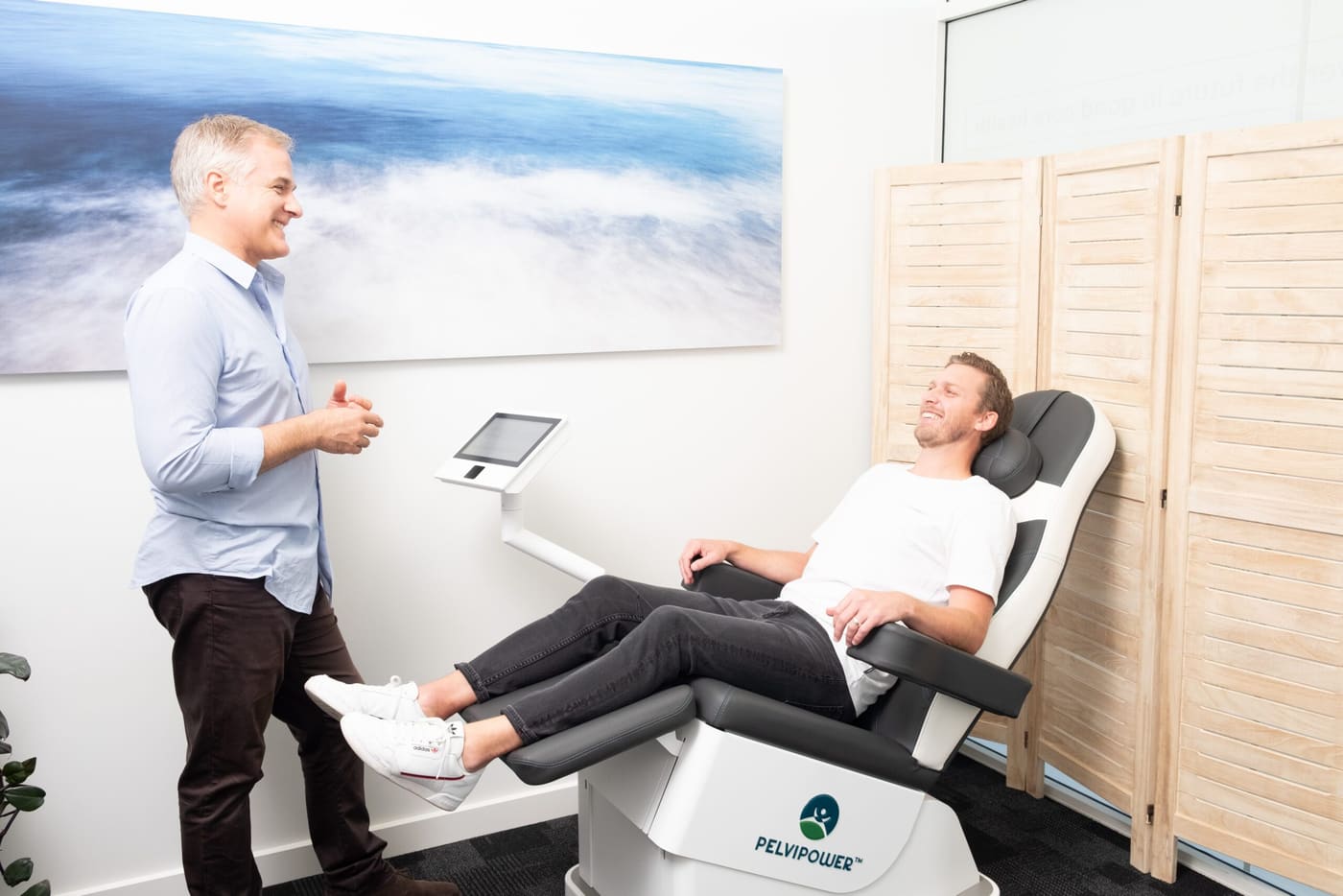
Some people also use one of the other options available here: real-time ultrasound for ongoing feedback, MAPLe HD EMG where detail is needed, PelviPower magnetic stimulation, the PelviPower biofeedback trainer, focused shockwave therapy or acupuncture. Those are chosen after assessment, and none of them replaces the physiotherapy. Technology supports clinical reasoning. It never replaces it.
What Improvement Can I Expect?
Honestly, it varies, and we will not know until we have assessed you. Muscle function changes over weeks rather than days, in the same way that any other strength or coordination work does. Some people notice a difference in their symptoms within two or three weeks. Some take a full programme before anything shifts. For some the change is substantial, for others it is partial, and a few need a different kind of help altogether, in which case we will say so and point you at it.
What we will do is tell you honestly, after your assessment, what we expect in your case, and measure it with the same objective tools each time so that progress is something we can show you.
What Does It Cost, and Do I Need a Referral?
| Detail | |
|---|---|
| Clinics | 2 Seaview Road, Paraparaumu Beach (Kāpiti Coast), and OraKinetics, The Pillars (next to Milson Pharmacy), 91 Milson Line, Palmerston North 4410 |
| Initial assessment | 60 minutes, $240, or $200 with ACC cover |
| Follow-up appointment | 30 minutes, $140, or $115 with ACC cover |
| Real-time ultrasound during an appointment | No additional charge |
| GP referral | Not required |
| Free 15-minute discovery call | No charge, ring 0800 267 346 |
ACC. ACC covers injury, not illness. Maternal birth injuries sustained on or after 1 October 2022 and pelvic injuries from a specific accident may be covered. Age-related stress incontinence, overactive bladder, erectile dysfunction, prolapse following a birth before 1 October 2022 and chronic pelvic pain with no injury behind it are not.
Nathan is an ACC registered provider, and he is credentialed for the ACC Maternal Birth Injury service. That means a maternal birth injury can be registered here and the care provided here, rather than you having to go somewhere else first to have the claim lodged. Full detail on the fees and ACC page.
Not Ready to Book Yet?
Ring 0800 267 346 and ask for a free 15-minute discovery call with Nathan. Fifteen minutes, no charge, no obligation, and you can describe the problem in whatever words you have for it.
Common Questions
Do I have to take my clothes off?
Not for the conversation, not for biofeedback, and not for ultrasound taken through the abdomen. Ultrasound taken through the perineum, and any internal assessment, do require undressing from the waist down. Both are explained and agreed before anything happens, and you are covered with a sheet.
Who will see me?
Nathan Scott, BPhty (Otago), physiotherapist since 1994, working in pelvic health for more than a decade. He is the only clinician seeing pelvic health patients, at both sites.
Can I see a female physiotherapist?
No. Nathan is the only physiotherapist at both clinics. If seeing a woman matters to you, say so when you ring and we will tell you honestly where else to look.
What should I bring?
Any letters from your GP, specialist or hospital, a list of your current medications, and if bladder symptoms are the main issue, a note of how often you went to the toilet over two typical days. None of it is essential.
Is it painful?
Assessment should not hurt. If something is uncomfortable, say so and we will stop or change what we are doing. Some manual therapy and some exercise can be briefly uncomfortable, and you set the limit.
How many appointments will I need?
There is no single answer. Some people need assessment and a home programme. Others benefit from a structured programme over several weeks. You will get an estimate after your assessment rather than a package sold up front.
Is what I tell you confidential?
Your clinical records are held under the Health Information Privacy Code. We do not write to your GP or anyone else without your permission.
I had a baby years ago. Is it too late?
No. Pelvic floor function responds to training at any age. Whether ACC will fund it is a separate question and depends on the date and nature of the birth injury.
Ready to Take the First Step?
You don’t need to know what’s causing the problem before booking. The first appointment is about working out what’s changed, and telling you honestly what can be done about it.
Phone: 0800 267 346 | Email: hello@coregood.co.nz Clinics at Paraparaumu Beach and Palmerston North.
Take the First Step
You don't need to know exactly what's wrong before asking for help. If you would rather ask before you book, start with a free 15-minute discovery call. It is a phone conversation, not a sales call, and there is no obligation to book anything afterwards.