
PelviPower Pelvic Functional Magnetic Stimulation
Helping restore healthier pelvic floor function through evidence-informed neuromuscular rehabilitation.
The pelvic floor is one of the most adaptable muscle systems in your body. It needs to contract, relax, coordinate and respond automatically throughout everyday life. When that adaptability changes, symptoms such as bladder leakage, urgency, pelvic pain and changes in sexual function can develop.
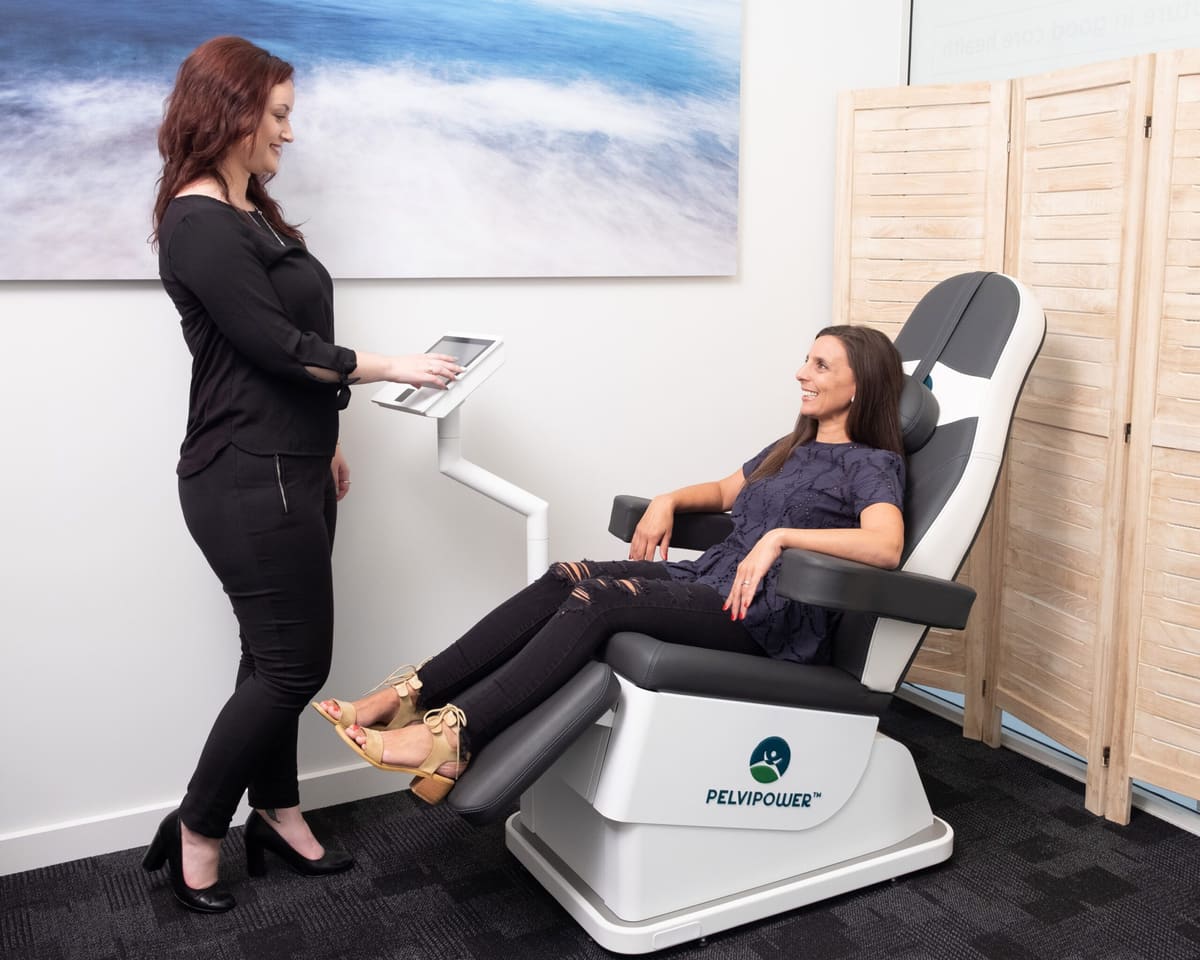
PelviPower uses Pelvic Functional Magnetic Stimulation (PFMS) to improve the way your pelvic floor and nervous system work together as part of a personalised rehabilitation programme. You remain fully clothed and comfortably seated, nothing is inserted and nothing is attached to you. It is one option within a pathway, chosen after assessment, and there is a list of people it is not suitable for. Both of those things are on this page.
What this page covers
- ✓What PelviPower is, and how functional magnetic stimulation works
- ✓The physiological changes it aims to produce
- ✓Which conditions may benefit
- ✓What the research currently shows
- ✓What a session is like, including what it feels like
- ✓Who the chair is not suitable for
- ✓How we decide whether it belongs in your pathway
- ✓What a programme looks like, and what it costs
What Is PelviPower?
PelviPower is a form of Pelvic Functional Magnetic Stimulation (PFMS) that stimulates the nerves controlling your pelvic floor muscles.
Unlike voluntary pelvic floor exercises, magnetic stimulation activates the muscles automatically while you remain fully clothed and comfortably seated. The treatment is completely non-invasive, requires no probes or electrodes and is generally well tolerated.
PelviPower isn't simply designed to make muscles contract. Its purpose is to help restore healthier pelvic floor function by improving the way your muscles and nervous system work together.
How Does the PelviPower Chair Work?
The seat of the chair contains a coil. When current passes through that coil it generates a rapidly changing magnetic field, which passes through clothing, skin, fat and bone without being absorbed by them. Inside the tissue, that changing field induces a small electrical current. Where the induced current reaches a motor nerve, it depolarises the nerve, and the nerve does what a nerve does when it depolarises: it fires, and the muscle fibres it supplies contract.
The contraction is produced by your own motor nerves and your own muscles. The chair supplies the trigger, not the movement.
Because the field is delivered from the seat and passes through the pelvis, the muscles of the pelvic floor are recruited along with surrounding muscles of the pelvis, hips and buttocks. The device delivers these impulses repetitively, in cycles of contraction and rest, and intensity is set by the physiotherapist and adjusted to what you can comfortably tolerate.
Two things follow from that mechanism, and they cut in opposite directions.
The first is that a contraction can be produced in someone who cannot produce one voluntarily. If you cannot find your pelvic floor, if you have no sense of where it is, or if you have tried a home programme and never felt anything happen, the chair does not depend on you getting it right.
The second is that the chair contracts a pelvic floor whether or not more contraction is what you need. Plenty of people we assess have the opposite problem: a pelvic floor already held too tight, which needs to learn to release, and a strengthening programme is the wrong direction for them. That does not always rule the chair out. Frequency and intensity can be selected for tone, awareness and pain rather than for strength, and progressed according to how you respond. What it does mean is that the decision comes from an assessment rather than from your symptoms, which is why the chair follows one rather than replacing it.
What Happens Inside Your Body?
Healthy pelvic floor function depends on much more than muscle strength. Your brain, spinal cord, nerves and pelvic floor continually communicate to produce the right amount of muscle activity at the right time. PelviPower aims to improve this system in three important ways.
Restore neuromuscular control
Repeated magnetic stimulation activates the nerves supplying the pelvic floor, reinforcing communication between the brain and muscles. This repeated activation is thought to promote motor learning and neuroplasticity, improving muscle awareness, voluntary activation, coordination and confidence in using the pelvic floor during everyday life.
Improve pelvic floor performance
Like any skeletal muscle, the pelvic floor responds to progressive overload. Repeated contractions encourage improvements in strength, endurance, timing and automatic muscle recruitment, helping the pelvic floor respond more effectively during activities such as coughing, lifting, exercise and changes in abdominal pressure.
Support recovery and healthy muscle function
Healthy pelvic floor muscles need to do more than generate force. They also need to relax appropriately. When used as part of a personalised rehabilitation programme, PelviPower may help restore healthier patterns of muscle activity, reduce unnecessary muscle guarding and support recovery following pain, injury or surgery.
That last point is the one most often missed. A stronger contraction is not the goal in itself, which is why the assessment comes first and why the chair is not the answer for everyone.
How Better Pelvic Floor Function May Help Different Conditions
Because the pelvic floor contributes to many body systems, improving the way it functions may benefit a range of conditions. In every case below, PelviPower is one part of a rehabilitation programme rather than a treatment on its own.
| Bladder leakage | Improved strength, timing and automatic muscle recruitment help support urethral closure during coughing, lifting, exercise and everyday activities. |
|---|---|
| Urgency and overactive bladder | Improving pelvic floor function may help suppress inappropriate bladder contractions, improve voluntary control over urgency and reduce the sensation of needing to rush to the toilet. |
| Pelvic pain | Improved neuromuscular control and healthier muscle function may reduce protective muscle guarding and support recovery when combined with a comprehensive rehabilitation programme. |
| Recovery after prostate surgery | PelviPower may assist men in reconnecting with their pelvic floor, improving muscle recruitment and supporting the recovery of continence as part of post-prostate rehabilitation. |
| Erectile dysfunction | Where pelvic floor dysfunction contributes to erectile difficulties, improving strength, coordination and neuromuscular control may help support erection quality as part of a broader rehabilitation programme. |
| Premature ejaculation | When pelvic floor dysfunction contributes to reduced control, improving awareness, coordination and muscle control may assist arousal regulation and confidence. |
| Pelvic organ prolapse | Improved pelvic floor strength and coordination may enhance pelvic organ support, reduce symptoms and improve confidence during everyday activities. |
What Does the Research Show?
Pelvic functional magnetic stimulation has been studied across a range of pelvic floor conditions, with the strongest evidence currently relating to urinary incontinence. Research has included:
- stress urinary incontinence
- overactive bladder and urgency urinary incontinence
- post-prostatectomy urinary incontinence
- chronic pelvic pain
- other presentations of pelvic floor dysfunction
- pelvic floor dysfunction affecting sexual function
The strength of evidence varies between conditions. Magnetic stimulation has the most established research base for urinary incontinence, while evidence for other pelvic floor conditions remains developing.
The research behind this section
- Yang Z, Liao J, Zhang S, Zhang M, Qiao L (2025). Effectiveness of extracorporeal magnetic stimulation in the treatment of pelvic floor dysfunction: a systematic review and meta-analysis. Neurourology and Urodynamics 44, 1302–1317.
- Hou WH, Lin PC, Lee PH, Wu JC, Tai TE, Chen SR (2020). Effects of extracorporeal magnetic stimulation on urinary incontinence: a systematic review and meta-analysis. Journal of Advanced Nursing 76, 2286–2298.
- Unal B, Sarsan A, Yıldız N, Alkan H (2025). Efficacy of magnetic stimulation in men with urinary incontinence after radical prostatectomy: a randomized, quadruple-blind, sham-controlled clinical trial. Neurourology and Urodynamics 44, 1140–1148.
Being studied is not the same as being right for you. Like all rehabilitation, the best outcomes occur when treatment is guided by an individual assessment and incorporated into a comprehensive rehabilitation programme.
What Is a PelviPower Session Like?
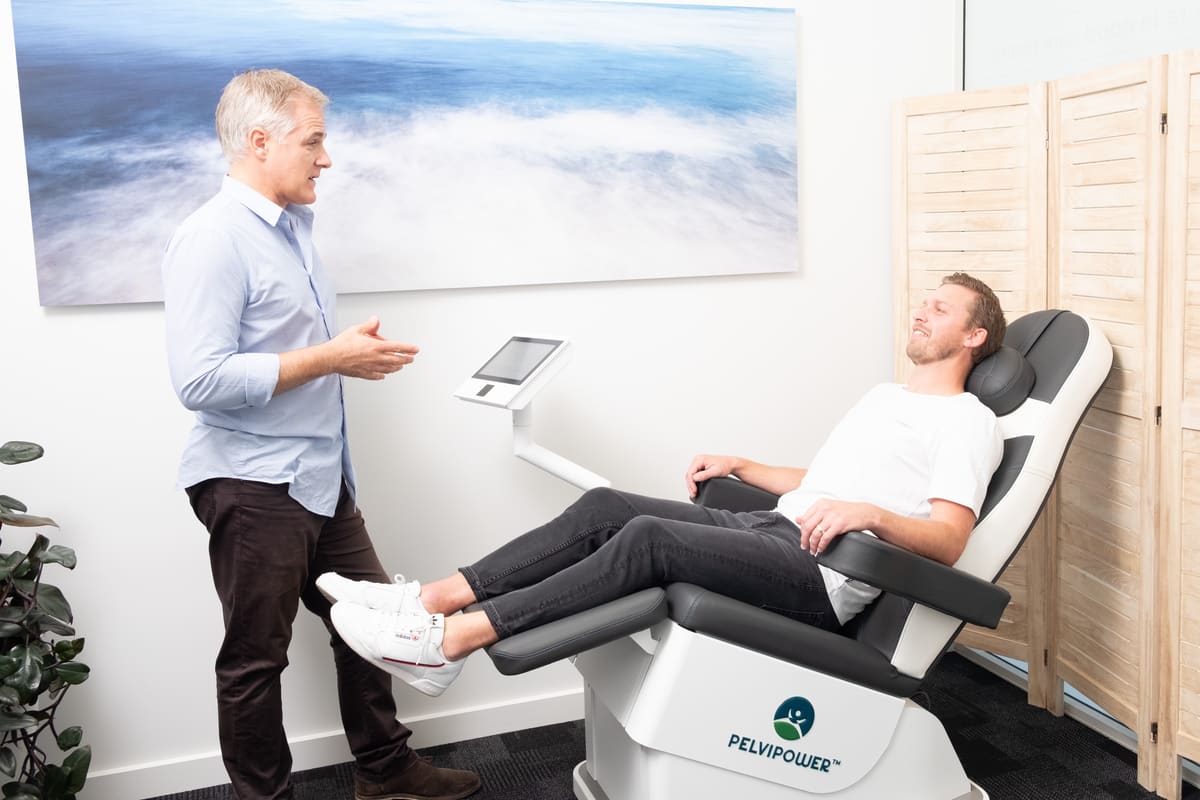
You stay dressed.
Ordinary clothes, no gown, no undressing, no probe, no gel, nothing attached to your skin. Avoid heavy metal belt buckles, zips, coins and phones in your pockets, and you will be asked to leave those outside the field.
You sit on the chair
and the physiotherapist positions you, because where you sit relative to the coil determines which muscles are recruited. Position is adjusted during the first session until the contraction is being felt in the right place.
The intensity is turned up gradually.
It starts low and builds. You will be asked what you can feel and where, and the setting is chosen with you rather than for you.
A session lasts 20 to 30 minutes
You sit through cycles of stimulation and rest. Most people describe the sensation as a strong tapping or pulling, and a distinct muscle contraction that they are not producing themselves. It is unfamiliar. It should not hurt. If it does, say so, and the intensity comes down.
You can read, or talk, or sit quietly.
Afterwards you get up and go. There is no recovery period and you can drive. Some people feel the muscles the next day in the way you would after any unfamiliar exercise. Tell us if that happens, because it usually means the intensity or the frequency needs adjusting.
How Many Sessions Would I Have?
There is no standard course, and we do not sell one up front.
A programme is agreed after your assessment and it depends on what we found, what you are working on and how you respond. At CoreGood, PelviPower is usually run once a week as part of a wider rehabilitation programme rather than as a course on its own.
Sessions are paid for one at a time. There is no block or package.
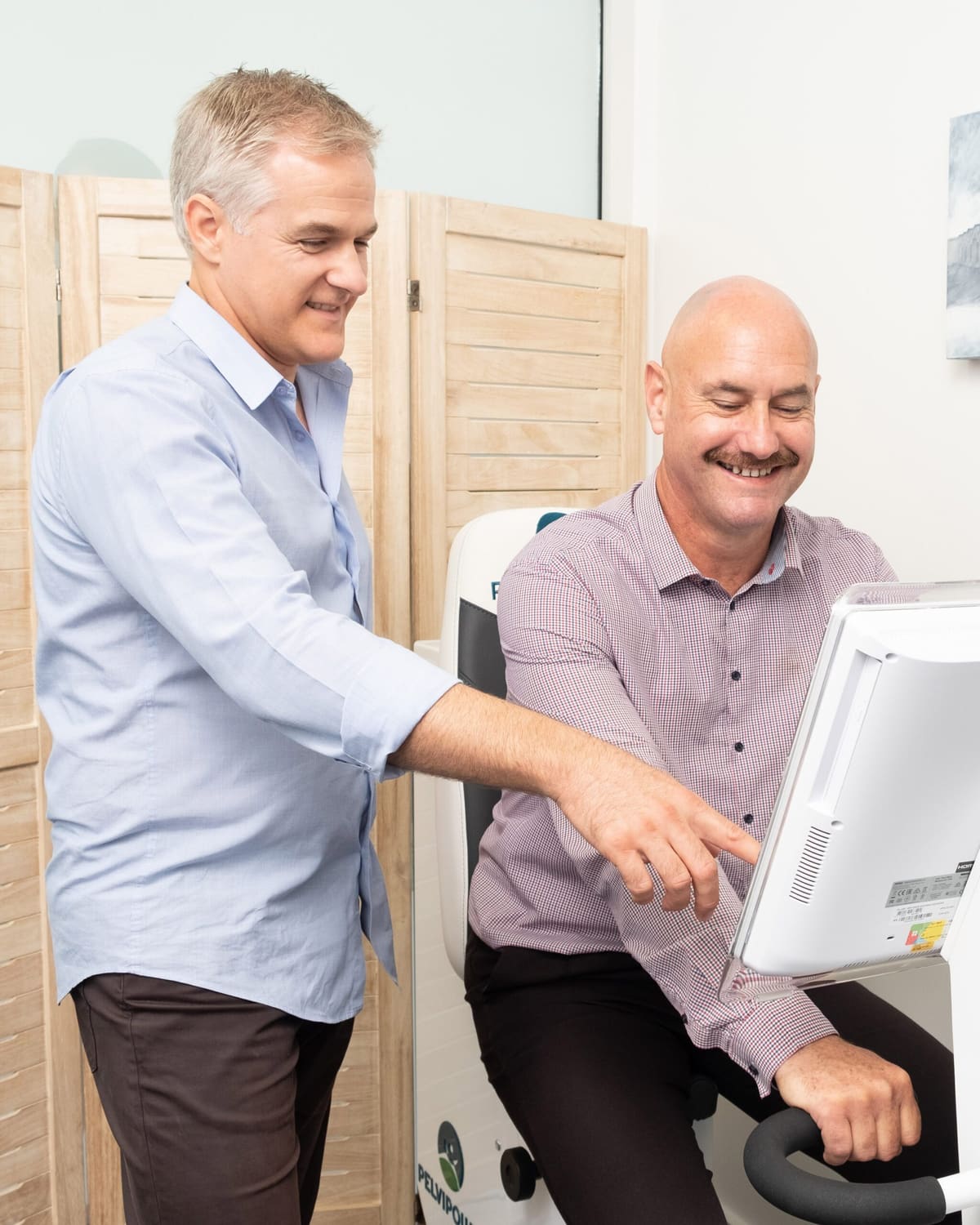
Everyone responds differently. Some people notice improvements in muscle awareness or symptom control within the first few sessions, while others improve more gradually as the muscles and nervous system adapt. Muscle work takes weeks, and that is as true of the pelvic floor as of any other muscle group, whether the contraction is produced voluntarily or by stimulation. We will reassess as we go, using the same objective measures we used at the start, so that any change is something we can show you rather than something we ask you to feel.
Sessions on the chair sit alongside the rest of your programme. They do not replace pelvic health physiotherapy, habit change or a home programme, and on their own they address only one part of a picture that usually has several parts.
Is PelviPower Right for Me?
You don't need to know whether PelviPower is the right option for you. That's our job.
Your assessment is designed to identify how your pelvic floor is functioning and whether PelviPower is likely to add value as part of your personalised rehabilitation programme. If it's appropriate, we'll explain why. If another approach is likely to achieve a better outcome, we'll recommend that instead.
That decision comes from the assessment, and only from the assessment.
We look at whether you can produce a voluntary pelvic floor contraction at all, whether you can release it afterwards, whether your pelvic floor is underactive or overactive, and whether a home programme is realistic for you. Someone who cannot find the muscle, or who has tried and got nowhere, is a very different case from someone whose pelvic floor is already working hard and will not switch off.
We will tell you plainly if we do not think the chair is the right tool for your situation, including when you have come in specifically asking for it. That happens reasonably often. A chair that produces a strong contraction is not a solution in itself, and it does not become one because it is impressive to sit on.
Technology supports clinical reasoning. It never replaces it.
Common Questions
Is PelviPower painful?+
No. Most people describe it as a strong but comfortable pulsing or contracting sensation. The intensity is gradually increased throughout your programme and adjusted to an appropriate level for you.
Do I need to remove my clothing?+
No. Treatment is performed while you're fully clothed. There are no probes, electrodes or internal devices.
Does PelviPower replace pelvic floor exercises?+
Not usually. PelviPower is designed to complement a personalised rehabilitation programme.
Many people still benefit from pelvic health physiotherapy, home exercises, breathing retraining and education alongside treatment.
How many treatments will I need?+
Treatment programmes vary depending on your symptoms, assessment findings and goals.
Following your assessment, we'll recommend the programme most appropriate for your individual situation and monitor your progress throughout rehabilitation.
When will I notice improvement?+
Everyone responds differently. Some people notice improvements in muscle awareness or symptom control within the first few sessions, while others improve more gradually as the muscles and nervous system adapt.
Can PelviPower help if my pelvic floor is overactive?+
Potentially, yes. Healthy pelvic floor function depends on producing the right amount of muscle activity at the right time, not simply stronger contractions.
When assessment identifies poor coordination or persistent overactivity, PelviPower may help improve neuromuscular control and support healthier patterns of muscle activity as part of a broader rehabilitation programme.
Are there people who shouldn't have PelviPower?+
Yes. Because PelviPower uses a powerful magnetic field, it isn't suitable for everyone. Certain implanted electronic devices, some metal implants, pregnancy and specific medical conditions may prevent treatment.
We'll review your medical history before recommending PelviPower to ensure it's safe and appropriate. The full list is in the safety section above, and it is worth reading before you book.
Ready to Take the Next Step?
You don't need to know whether PelviPower is right for you before reaching out. That's our job.
Your first appointment is about understanding how your pelvic floor is functioning and determining whether PelviPower has a meaningful role within your personalised rehabilitation programme. If it's the right tool, we'll explain why. If another approach is likely to produce a better outcome, we'll recommend that instead.