
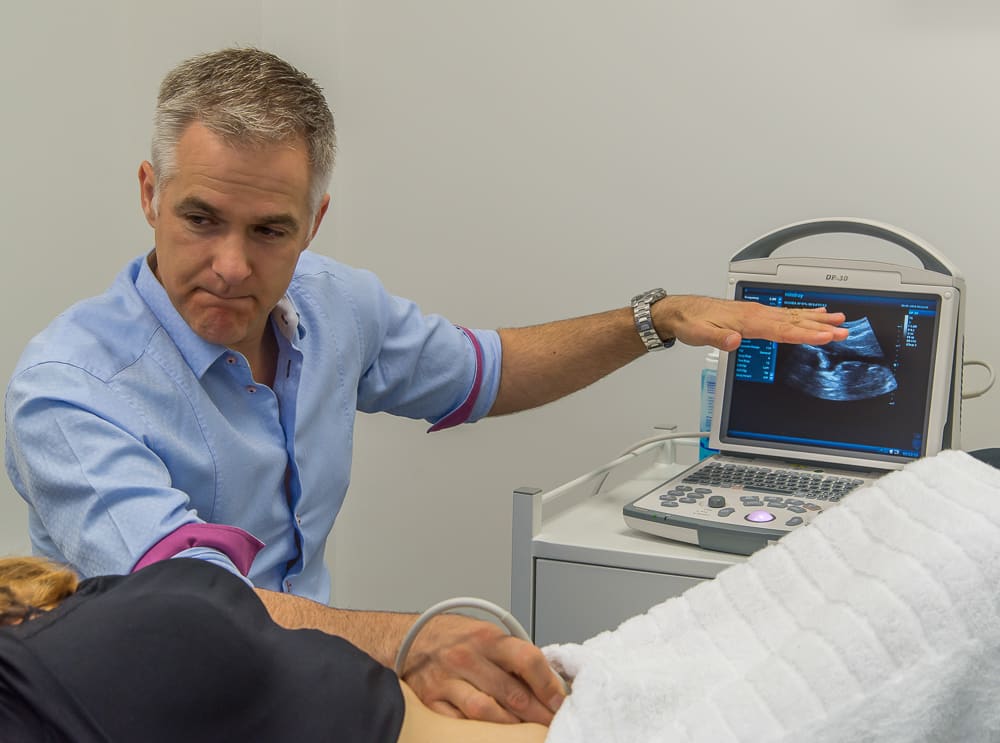
See how your pelvic floor actually moves.
The pelvic floor sits deep inside the pelvis, which makes it difficult to see and sometimes surprisingly difficult to feel.
You may think you’re contracting correctly when you’re barely moving the muscles, pushing down instead of lifting, holding your breath or struggling to relax afterwards.
Real-time ultrasound changes that.
Using safe, non-invasive ultrasound imaging, we can watch your pelvic floor move as you contract, relax, breathe and manage pressure. You can see the same image at the same time, helping turn an invisible movement into something you can understand and learn to control.
At CoreGood, real-time ultrasound is used both to assess how your pelvic floor is functioning and to help you learn how to use it more effectively.
What Is Real-Time Ultrasound Biofeedback?
Real-time ultrasound uses the same type of ultrasound technology commonly used throughout healthcare to create a moving image of structures inside the body.
In pelvic health physiotherapy, it allows us to observe how the pelvic floor responds while you:
Contract
Relax
Breathe
Cough
Move
Manage changes in abdominal pressure
The image appears immediately on a screen, allowing both you and your physiotherapist to see what is happening.
For many assessments, imaging can be performed through the lower abdomen while you remain fully clothed apart from exposing a small area of your abdomen.
Where clinically useful, ultrasound can also be positioned externally over the perineum to provide a different view of pelvic floor movement.
Why Seeing Movement Matters
Healthy pelvic floor function isn’t simply about strength.
The muscles need to contract, relax, coordinate with breathing and respond automatically to the changing demands placed on your body.
Symptoms alone don’t always tell us how well that’s happening.
Real-time ultrasound allows us to observe the movement directly.
We can see whether your pelvic floor lifts when you contract, whether it relaxes afterwards, how well you coordinate the movement and how it responds when pressure changes.
That information helps reduce guesswork and makes rehabilitation more specific to you.
What Can We Assess?
Real-time ultrasound can provide useful information about several aspects of pelvic floor function.
Muscle Activation
We can observe whether you’re able to generate an effective pelvic floor contraction and whether the movement is occurring in the direction we expect.
Relaxation
A healthy pelvic floor also needs to let go.
Ultrasound helps us assess whether the muscles return towards their resting position after contraction rather than remaining unnecessarily active.
Coordination
We can observe how your pelvic floor responds during different tasks rather than assessing a contraction in isolation.
Breathing & Pressure Management
This is one of the most valuable ways we use ultrasound at CoreGood.
Your diaphragm, abdominal muscles and pelvic floor normally work together as an integrated pressure-management system.
Real-time imaging allows us to teach you how to coordinate pelvic floor movement with breathing and then progress that skill into lifting, exercise and everyday movement.
Rather than simply telling you what should happen, you can see it happen.
Bladder Function
Ultrasound can also help us assess bladder filling and, where clinically appropriate, estimate whether urine remains after emptying.
This can provide useful additional information when bladder emptying is part of the clinical picture.
From Assessment to Learning
Real-time ultrasound isn’t valuable simply because it gives us another measurement.
Its biggest advantage is that you get to see the movement too.
If the pelvic floor moves correctly, you can connect what you’re seeing with what you’re feeling.
If it doesn’t, we can change your breathing, technique, effort or position and immediately see whether the movement improves.
That creates a simple learning cycle:
↓
↓
↓
↓
Over time, the goal is that you no longer need the screen.
The movement becomes something your nervous system can reproduce confidently and automatically in everyday life.
How Real-Time Ultrasound May Help
We may use ultrasound biofeedback as part of rehabilitation for people experiencing:
Bladder Leakage
Learn to generate and coordinate an effective pelvic floor response during coughing, lifting, exercise and other increases in abdominal pressure.
Urgency & Bladder Symptoms
Improve awareness of pelvic floor activation and relaxation as part of bladder retraining and better pelvic floor control.
Pelvic Organ Prolapse
Learn to coordinate the pelvic floor with breathing and pressure management during lifting, exercise and everyday activity.
Pelvic Pain
Assess whether the pelvic floor is moving and relaxing appropriately and use visual feedback to support relaxation and reduce unnecessary guarding.
Recovery After Prostate Surgery
Help men reconnect with their pelvic floor, improve contraction technique and coordinate muscle activation during the return of bladder control.
Erectile & Sexual Function
Where pelvic floor dysfunction contributes to symptoms, ultrasound can help assess and retrain contraction, relaxation and coordination as part of a broader rehabilitation programme.
How Is This Different From Our Other Assessment Tools?
Different tools answer different questions.
Real-Time Ultrasound Shows us movement and is particularly useful for non-invasive assessment, visual learning, breathing and pressure coordination.
Real-Time Biofeedback Training Helps you practise and improve motor control through immediate feedback during rehabilitation.
MAPLe EMG Provides much more detailed information about electrical activity in different regions and layers of the pelvic floor, and can also provide targeted rehabilitation when that additional precision is clinically useful.
PelviPower Provides neuromuscular stimulation when improving recruitment, strength, coordination or muscle function is part of the rehabilitation goal.
We don’t use more technology simply because it’s available.
We use the simplest tool that gives us the information or rehabilitation stimulus we actually need.
Is Real-Time Ultrasound Right for Me?
You don’t need to know whether ultrasound biofeedback would help before booking.
That’s our job.
We’ll assess your symptoms and pelvic floor function and determine whether seeing the muscles move in real time is likely to improve our understanding or help you learn more effectively.
For many people, it’s an excellent place to begin because it provides valuable information without requiring an internal examination.
Common Questions
Does ultrasound hurt?
No.
Ultrasound imaging itself is painless. A small amount of gel is placed between the ultrasound probe and your skin.
Is it an internal examination?
Usually not.
Much of our pelvic floor ultrasound assessment can be performed externally through the lower abdomen. In some situations, an external perineal view provides useful additional information.
If another form of assessment is likely to add value, we’ll explain why before recommending it.
Do I have to undress?
For abdominal imaging, you’ll generally only need to expose a small area of your lower abdomen.
Is ultrasound the same as biofeedback?
Ultrasound can be used as biofeedback because you can watch your pelvic floor move in real time.
Its particular strength is showing movement and allowing you to connect what you see with what you feel.
Does everyone need ultrasound?
No.
Like every assessment tool at CoreGood, we use it when it is likely to provide useful information or improve your rehabilitation.
Ready to See How Your Pelvic Floor Is Functioning?
You don’t need to know whether you’re contracting, relaxing or coordinating your pelvic floor correctly before asking for help.
That’s our job.
Your first appointment is about understanding how your pelvic floor is functioning and identifying the factors contributing to your symptoms.
Where real-time ultrasound can reduce guesswork or help you learn more effectively, we’ll use it as part of your personalised assessment and rehabilitation.
Take the First Step
You don't need to know exactly what's wrong before asking for help. If you would rather ask before you book, start with a free 15-minute discovery call. It is a phone conversation, not a sales call, and there is no obligation to book anything afterwards.