
High-definition pelvic floor assessment and targeted rehabilitation when standard assessment hasn’t explained the whole picture.
Most people who come to CoreGood never need a MAPLe assessment.
For the majority of people, a thorough clinical assessment, real-time ultrasound and non-invasive biofeedback provide all the information we need to develop an effective rehabilitation programme.
Occasionally, however, symptoms don’t match the findings, progress has stalled, or we need a much more detailed understanding of how individual muscles within the pelvic floor are functioning.
That’s when MAPLe can provide information that no other assessment can.
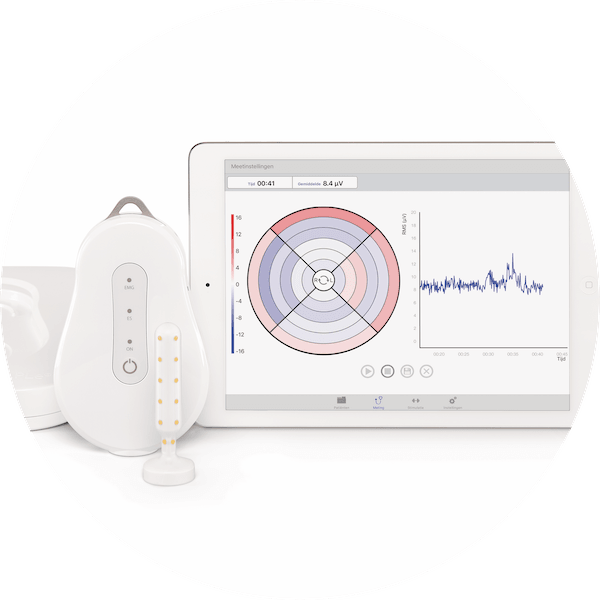
MAPLe is a high-definition pelvic floor EMG system that allows us to assess individual regions of the pelvic floor rather than treating it as one single muscle.
Unlike many assessment technologies, MAPLe doesn’t simply identify the problem. It can also become part of your rehabilitation by providing targeted electrical stimulation and biofeedback to the specific muscles that need attention.
Our goal isn’t to perform more investigations.
It’s to perform the right investigation, at the right time, and use that information to guide the most effective rehabilitation.
Why Most People Don’t Need MAPLe
One of the strengths of modern pelvic health assessment is that many important questions can now be answered without an internal examination.
A detailed history, clinical assessment, real-time ultrasound and non-invasive biofeedback often provide everything needed to develop an effective rehabilitation programme.
MAPLe is reserved for situations where those assessments haven’t provided enough information or where greater precision is likely to influence treatment decisions.
If the result isn’t going to change your rehabilitation programme, we won’t recommend the assessment.
What Is MAPLe?
MAPLe (Multiple Array Probe Leiden) is a high-definition pelvic floor EMG system designed to measure electrical activity from different regions of the pelvic floor.
Unlike conventional biofeedback, which provides an overall picture of pelvic floor muscle activity, MAPLe shows how individual muscle regions are contributing.
It can distinguish:
Left and right sides
Superficial and deeper muscle layers
Resting muscle activity
Muscle activation
Relaxation
Endurance
Timing and coordination
This provides a level of detail that is simply not available with conventional assessment.
Importantly, MAPLe is more than a diagnostic tool.
It can also provide targeted electrical stimulation and real-time biofeedback, allowing rehabilitation to focus on the specific muscles identified during assessment.
Why Precision Matters
The pelvic floor isn’t one muscle.
It’s a group of muscles working together, each with different roles.
Sometimes the overall pelvic floor appears to function reasonably well while one specific muscle remains underactive, another remains overactive, or one side contributes much less than the other.
Without detailed assessment, those differences can remain hidden.
Imagine two people with bladder leakage.
Both appear to have weak pelvic floor muscles.
Both could easily be given exactly the same exercise programme.
MAPLe may reveal that one person needs to improve muscle activation, while the other needs to learn how to relax an overactive muscle before strengthening will be effective.
The symptoms look similar.
The rehabilitation is completely different.
That’s why precision matters.
What Can MAPLe Assess and Treat?
MAPLe allows us to measure pelvic floor function with remarkable precision.
It helps us understand:
Resting muscle activity
Left versus right muscle balance
Superficial versus deep muscle function
Muscle activation and timing
Relaxation after contraction
Endurance
Coordination between different muscle regions
Unlike most assessment systems, MAPLe can also become part of your rehabilitation.
When clinically appropriate, it can:
Target Underactive Muscles
Deliver electrical stimulation to specific muscles that are not activating effectively, helping improve neuromuscular recruitment and voluntary muscle control.
Help Normalise Overactive Muscles
Selected stimulation programmes, combined with biofeedback and physiotherapy, may assist people whose pelvic floor muscles remain overactive or poorly coordinated, helping restore healthier muscle behaviour.
Guide Motor Learning
Real-time visual feedback allows you to see how individual muscle regions respond while learning to contract, relax and coordinate your pelvic floor more effectively.
Measure Progress Objectively
Because the same muscles can be reassessed over time, MAPLe provides an objective way of monitoring how your rehabilitation is progressing rather than relying solely on symptoms.
From Precision Assessment to Precision Rehabilitation
One of MAPLe’s greatest strengths is that assessment and rehabilitation occur within the same system.
Rather than identifying a problem and then guessing how the muscles respond to treatment, we can reassess exactly the same muscle regions over time.
This allows rehabilitation to become more individualised, more precise and more responsive to your progress.
The goal isn’t simply to identify what’s wrong.
It’s to understand what needs to change, help it change, and objectively measure whether it has changed.
What Happens During a MAPLe Assessment?
Before anything else, we talk.
We’ll explain why we’re recommending MAPLe, what we hope to learn and whether the additional information is likely to influence your rehabilitation.
If you decide to proceed, you’ll remain covered throughout the assessment except during probe insertion.
The lubricated probe may be inserted by you or, if you prefer, by your physiotherapist.
Most people describe the sensation as unusual rather than painful. If you’re uncomfortable at any stage, we’ll stop.
During the assessment you’ll be asked to relax, contract, hold, cough or bear down while the system records how different regions of your pelvic floor respond.
Afterwards, we’ll review the results together, explain what they mean in plain language and discuss how they influence your rehabilitation programme.
When Do We Recommend MAPLe?
We consider MAPLe when greater precision is likely to improve clinical decision-making.
Examples include:
Progress has stalled
Symptoms haven’t improved despite appropriate rehabilitation.
We need to determine whether muscle recruitment or the rehabilitation strategy should change.
We suspect a more complex problem
Persistent pelvic pain
Muscle asymmetry
Previous pelvic surgery or childbirth injury
Suspected muscle damage
Greater precision is likely to improve rehabilitation
Difficulty finding or activating the pelvic floor
Complex bowel dysfunction
Long-term progress monitoring
Before recommending MAPLe we ask one simple question:
If the answer is no, we won’t recommend the assessment.
Is MAPLe Right for Me?
MAPLe may be appropriate if:
Your symptoms haven’t been fully explained by standard assessment.
Greater precision is likely to improve your rehabilitation.
You’re comfortable having an internal assessment.
You and your physiotherapist agree the additional information is worthwhile.
It may not be appropriate if:
You’d prefer not to have an internal assessment. That’s completely okay—we’ll continue with non-invasive assessment methods.
You have an active vaginal, urinary or rectal infection.
You’re recovering from recent pelvic surgery or childbirth.
There are other medical reasons why MAPLe isn’t appropriate.
We’ll always discuss suitability before recommending it.
Common Questions
Is MAPLe only an assessment?
No.
MAPLe combines high-definition assessment, targeted electrical stimulation and real-time biofeedback within the same system. For some people it’s purely an assessment tool. For others it also becomes part of their rehabilitation by helping retrain specific muscles identified during assessment.
Does it hurt?
Most people describe the assessment as unusual rather than painful.
If you’re uncomfortable at any stage, we’ll stop.
Will I need more than one MAPLe assessment?
Usually not.
However, repeat assessment can be valuable when objectively measuring progress in more complex rehabilitation programmes.
Do I have to have MAPLe to improve?
No.
Most people achieve excellent outcomes using standard assessment, real-time ultrasound, non-invasive biofeedback and physiotherapy.
MAPLe is reserved for situations where the additional precision is likely to improve your rehabilitation.
Can I stop the assessment at any time?
Absolutely.
You’re always in control and can pause or stop the assessment whenever you wish.
Ready to Take the First Step?
You don’t need to know whether MAPLe is the right assessment or rehabilitation tool for you.
That’s our job.
Your first appointment is about understanding your symptoms and determining whether standard assessment provides the answers we need. If greater precision is likely to improve your rehabilitation, we’ll explain how MAPLe may help. If a simpler approach is more appropriate, we’ll recommend that instead.
Our goal is always the same:
To understand your pelvic floor as accurately as possible, deliver the most appropriate rehabilitation, and objectively measure your progress along the way.
Take the First Step
You don't need to know exactly what's wrong before asking for help. If you would rather ask before you book, start with a free 15-minute discovery call. It is a phone conversation, not a sales call, and there is no obligation to book anything afterwards.